"It is expected that... secretions from P. bicolor will advance towards
useful and safe treatments,
where once again traditional knowledge helps future generations"
— The Amazonian kambô frog Phyllomedusa bicolor: Current knowledge on
biology...1
The Science of Kambo: Peptides, Research, and Human Biology
How does kambo interact with the human body, and what does
scientific research say about its mechanisms? When Italian scientist
Vittorio Erspamer first analyzed kambo in the lab, he described it
as "a fantastic chemical cocktail with potential medical
applications, unequalled by any other amphibian". He later wrote
that "no other amphibian skin can compete with that of the
Phyllomedusidae" - the start of nearly four decades of research into
kambo's peptides and the remarkable synergy they display for human
biology.
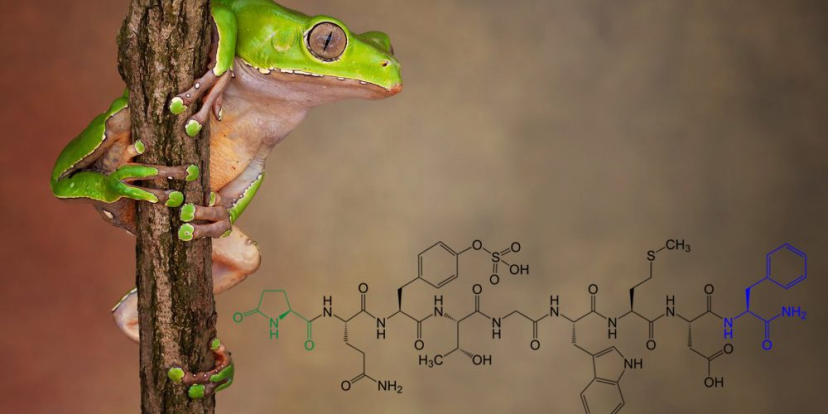
Unlike its mistaken misnomer of 'poison', kambo is more accurately
described as a trove of bioactive peptides - messenger
molecules that our bodies already recognize. Peptides are short chains
of amino acids - the same building blocks used by our bodies - things
like insulin, oxytocin, and endorphins are all peptides. They're the body's
messengers: tiny signals that tell cells when to repair, defend, calm
inflammation, regulate pain, or restore balance.
"Host defence peptides are involved in the stimulation of the protective
immune response, while suppressing the harmful inflammatory response. The
organizations of amphibian and mammalian immune systems share numerous
similarities in terms of the functions of both innate and adaptive
immunity."— “The Potential of Frog Skin-Derived Peptides for Development into
Therapeutically-Valuable Immunomodulatory Agents”2
Is Kambo a Poison? "Poison" vs Peptides Explained
What makes kambo so uniquely attuned to humans is that the skin of
the kambo frog (Phyllomedusa bicolor) has evolved many
peptides with direct counterparts to those found in mammalian brain,
gut, and immune systems. As researchers have noted: "frog skin
secretions are a rich source of biologically active neuropeptides
and hormones closely resembling mammalian peptides produced in the
brain and gastrointestinal tract."3
As noted by David Attenborough, these Host Defense Peptides (HDPs) are a kind of
anti-bacterial 'sunscreen' that the frog applies to itself, rather than
a toxin like poison dart frogs. With no records of adult P. bicolor
being preyed on or found among the stomach contents of any predators1 due to its large size and camouflage, its secretion instead protects
the frog from bacteria, fungi, and viruses in the humid Amazon.
For humans however, since our bodies are inherently familiar with
these compounds - having similar 'keys' in our own nervous and
immune systems - the body instinctively accepts these peptides
rather than fighting them.
"Clinicians will most probably define this above described symptom-complex
as an anaphylactic shock. However, all these symptoms can be attributed to
the pharmacological activity of the peptides of Kambo, and thus the
symptom-complex seems not to be anaphylactic of nature, but directly
related to its pharmacological effects."— “Kambo and its Multitude of Biological Effects: Adverse Events or
Pharmacological Effects?”4
Kambo Pharmacology: Can You Overdose? Understanding Kambo's Effects
Unlike drugs, which force a narrow effect by blocking or overriding
a single target, peptides work differently, acting like keys that
fit pre-existing locks, signalling systems the body already uses to
heal, defend, and regulate itself. Rather than imposing external
effects, they spur the body's own processes from within.
This is why it's highly misinformed to describe kambo as a "poison"
or "drug" despite the intense physical response - it cannot cause
death or overdose entirely on its own, as the body is able to
self-manage its uptake and usage of these peptides4.
(Note: this is not to say that kambo is always safe for everyone -
see kambo safety information)
Once the receptors are saturated, adding more doesn't increase the
intensity - the effect simply plateaus, as the body manages the
intensity itself through a biological process called tachyphylaxis. If the receptors are hit with a massive wave of peptides, they
essentially 'shut the door' to prevent the kind of overdose you get
from drugs or medicines - demonstrated by the fact that observations
of indigenous use record upwards of 50 to 100 points applied at once1.
Kambo Half-Life and Recovery: Is Kambo a Toxin?
While drugs must be processed by the liver, kambo's peptides are
simple amino acids that are easily broken down by enzymes in the
blood. The body is so efficient at this that the half-life of kambo
is measured in minutes.
This rapid cleanup is why kambo users recover so quickly; the active
molecules simply don't stay in the system very long. Kambo is not
the dangerous toxin it's often presumed to be, but a peptide
treasury whose components are recognized by - and co-operate with -
the same levers that govern human health.5,6,7
That co-operation is what makes kambo so scientifically captivating:
within this natural chemical library are numerous compounds forming
a synergistic orchestra, helping explain why indigenous peoples
prized kambo for its benefits to strength, resilience, clarity, and overall
wellbeing. While the true value of kambo comes from this synergy, studying
its components individually helps research map the scientific basis for
the resilience and wellbeing that indigenous use has long described.
From Tradition to Science - Highlights from the Research
While indigenous usage has long relied on kambo to clear stagnation and
sharpen the body's natural defenses, modern science is still exploring how
these underlying mechanisms interact with mammalian biology. The highlights
below examine peer-reviewed laboratory research into how individual peptides
function as precise biological messengers. Rather than evaluating kambo as a
medical treatment or clinical intervention, this evidence-based overview
outlines how science is reverse-engineering the synergistic mechanisms that
complement - and help explain - the resilience, vitality, and systemic reset
described in traditional accounts.
Cellular Defense and Antimicrobial Pathways
Research on Dermaseptin B2 highlights broad antibacterial,
antifungal, and antiviral effects2,8, noting a “key role in defense mechanisms against a broad
spectrum of pathogens, including enveloped viruses”9.
Beyond pathogen defense, preclinical studies show these peptides can
inhibit “the proliferation and colony formation of various human
tumor cell types”10 “without harmful effect on mammalian cells”3. In-vitro testing has most notably shown this in prostate tumor
cells, where it “inhibited the proliferation of the human prostatic
adenocarcinoma PC-3 cell line by more than 90%”11.
“We showed that Drs B2 inhibits the proliferation and colony
formation of various human tumor cell types... Furthermore, Drs B2
inhibited tumor growth of the human prostate adenocarcinoma cell
line PC3 in a xenograft model in vivo.”
— Antitumor and Angiostatic Activities of the Antimicrobial
Peptide Dermaseptin B210
The significance of this is highlighted by Queen's University in
Belfast, who have received awards for their ongoing cancer research
involving these specific frog secretions12.
Additionally, research into Dermaseptin B2 (Adenoregulin) shows it
supports A1 receptors to become more sensitive to naturally
occurring adenosine, supporting the body's innate cellular defense
mechanisms to more efficiently protect the heart and brain during
severe stress13.
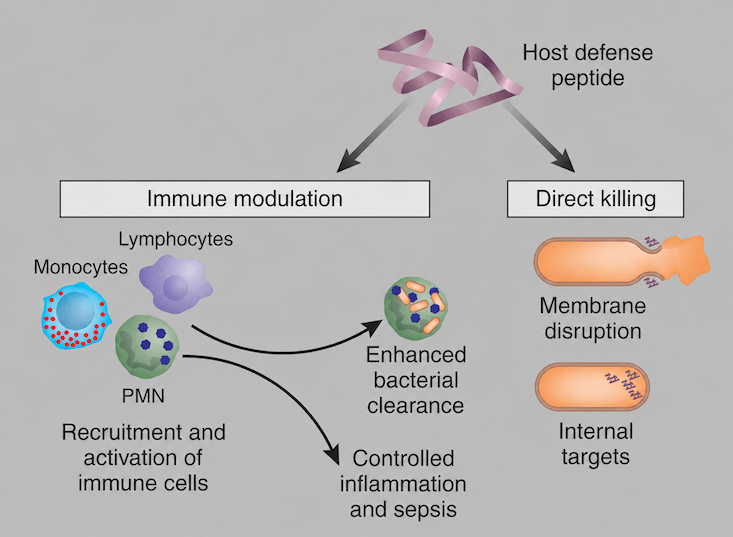
Illustration of biological roles of HDPs by innate immune modulation"Antimicrobial and host-defense peptides as new anti-infective
therapeutic strategies", Nature Biotechnology14
Vasodilation and Systemic Transport
The intense physical sensations associated with the onset of
the process
- such as a sudden "heat rush," a drop in blood pressure, and the
physical urge to purge - are primarily driven by the synergistic actions
of Phyllomedusin and Phyllokinin15,1.
Belonging to the tachykinin and bradykinin peptide families, these
compounds induce a rapid dilation of blood vessels, expanding the
body's circulatory pathways1,16. Rather than a random side effect, this vasodilation functions as
a sophisticated delivery system, facilitating the rapid systemic
transport of the other beneficial peptides across physiological
barriers, allowing them to reach their target receptors quickly and
efficiently17.
This circulatory opening directly correlates with traditional
usage - by clearing deep-seated vascular stagnation, this opening
of the circulatory system primed the system for heightened
awareness, enduring stamina, and sharp sensory focus required by
indigenous hunters.
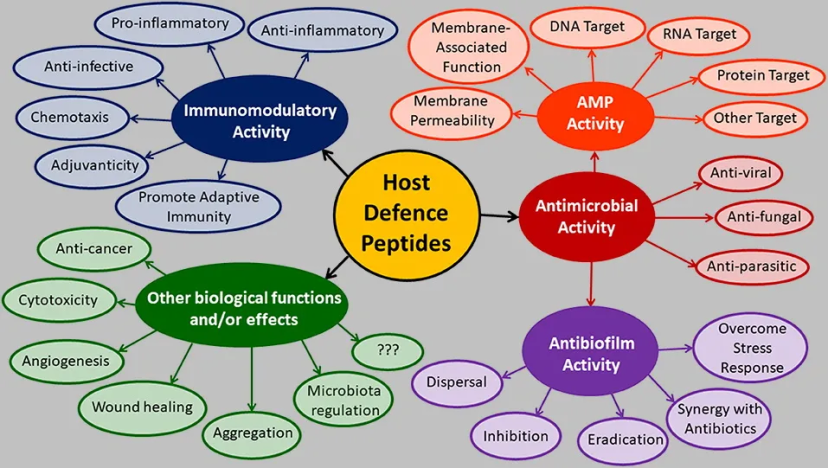
Diversity of biological functions described for HDPs
"Reassessing the Host Defense Peptide Landscape", Frontiers in
Chemistry18
Analgesia and Opioid-Receptor Selectivity
Another group of highly specialized molecules found in the secretion
- namely Dermorphin and Deltorphins - are studied for their
interactions with pathways governing pain and mood. Research
indicates these peptides possess potent analgesic effects that may
exceed standard clinical opioid options but with distinct
pharmacological profiles: unlike morphine, these peptides appear to
produce less tolerance, physical dependence, and side effects.19,20
A double-blind RCT from 1985 reported that “it was clear that
dermorphin was much more potent and long-lasting compared with
morphine,” noting a shorter hospital stay for the dermorphin group
compared to controls.
— Rediscovery of old drugs: the forgotten case of dermorphin for
postoperative pain and palliation21
Deltorphins operate with similar precision, possessing “a higher
affinity and selectivity for delta opioid binding sites than any
other natural compound known”19. By targeting these specific receptors, which govern mood and
chronic pain, researchers suggest a pathway to effective pain relief
without inducing the tolerance or dark withdrawal symptoms
associated with opiates20.
Gut-Brain Axis and Stress Response Regulation
The systemic "reset" often described following the process links to peptides regulating the vagus nerve, gut-brain axis, and central
nervous system.
22
Sauvagine mimics aspects of human hormones that modulate cortisol
pathways to manage stress and anxiety, while Caerulein stimulates
the digestive tract and prompts the liver to flush out accumulated
bile - supporting the body's natural elimination pathways rather
than recycling old toxins - while also regulating energy balance and
satiety.15,4
Pharmacologist Vittorio Erspamer concluded that an “increase in
physical strength, enhanced resistance to hunger and thirst and,
more generally, increase in the capacity to face stress situations
may be explained by the presence of caerulein and sauvagine”.
— Pharmacological studies of 'sapo' from the frog Phyllomedusa
bicolor skin17
Further supporting this homeostasis is Phyllolitorin, noted for
“impressive endocrine, cardiovascular and nervous system activities”23. For the Matsés, this banishes 'Panema' (lethargy), resulting
in an 'after-glow' of sharper sight, smell, and mental stillness
that can last for days.17